
Chapter 4 - How to Cross Stitch
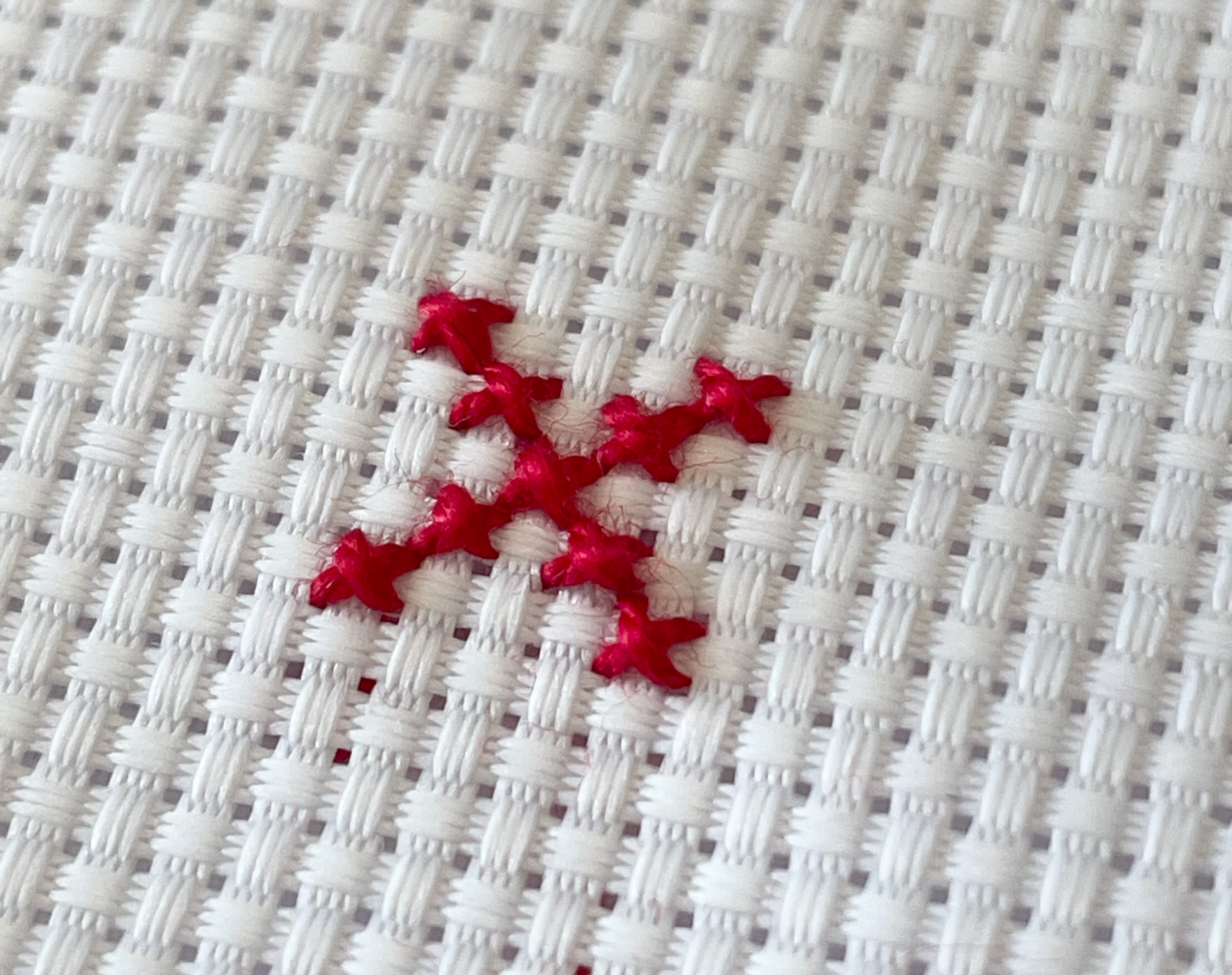
Now that your needle is threaded and fabric prepared, it’s time to learn the foundational stitch of Tatreez and all cross-stitch embroidery: the basic cross stitch. Every motif, border, and pattern is built from this simple “x” shape. Mastering it will give you the confidence to create more complex designs.
The Cross Stitch
Cross stitching primarily uses fabrics like Aida cloth and waste canvas. These materials are woven to create a grid, providing a guiding framework for your stitches. This fabric grid consists of evenly spaced points, and each cross stitch utilizes four (4) of these points.
A possible start point for a cross-stitch is the bottom left point (A in this image), but you may start in any corner that your specific motif calls for. For the learning purposes of this post, we will start our cross stitches from the bottom left.

1. Single Cross Stitch(X)
A cross stitch forms an "X" shape. To understand the concept of cross-stitching we will learn how to create a single cross-stitch first. Although the use of single cross stitches is infrequent, it forms the foundation for any stitch.

How to Create a Single Cross-Stitch
Insert your needle from the back of the fabric/Aida cloth through any point (A). Thread the needle completely through, ensuring that the knot at the end doesn't pass through.
Then, insert the needle from the front of the fabric diagonally to the next point (B), again threading it completely through. You have created a diagonal line.
Now, your needle will be at the back of your work. Insert the needle through any remaining un-stitched point (C) from the back.
Finally, insert the needle diagonally to the next point (D) from the front.
Congratulations, you've created a cross-stitch!
2. Half Stitching (XXX)
A half stitch is an excellent technique for creating rows and columns of incomplete "X"s. It is the preferred way to cross stitch, creating a neater backside of your work and minimizing thread wastage.

How to Create Half-Stitches
Start with any point (A), then insert it diagonally to the next point point (B) from the front.
Alternating between As & Bs until you've reached your desired number of stitches.
If you're making cross stitches in a horizontal line, point (C) technically becomes point (A) for the next stitch.
Then, insert the needle diagonally again to point (B) for the next stitch.
When you're ready to finish, work your way backward by stitching through Cs and Ds.
Vertical Half Stitching
We can then implement this technique by half-stitching vertically, creating columns.
In this vertical half-stitching example, we deviated from the (A-B-C-D) pattern. We swapped D with C to allow for vertical half-stitching, a tidy backside, and minimizing thread wastage.
With tatreez, you will find yourself stitching in different orders depending on what the design calls for.
